


Blog
How to Install a Speed Hump: A Step-by-Step Guide
Sep
Speed humps are one of the simplest, most effective ways to slow traffic down in carparks, driveways, and low-speed roads. If you manage a site where pedestrian safety is a concern, whether that’s a school carpark, a retail centre, or a residential complex, learning how to install a speed hump properly matters just as much as choosing the right product.
What Is a Speed Hump?
A speed hump is a raised section fitted across a driving surface, designed to force drivers to slow down as they pass over it. Unlike a speed bump, which is generally shorter and sharper, a speed hump has a more gradual profile, making it suitable for regular traffic while still being effective at reducing speed.
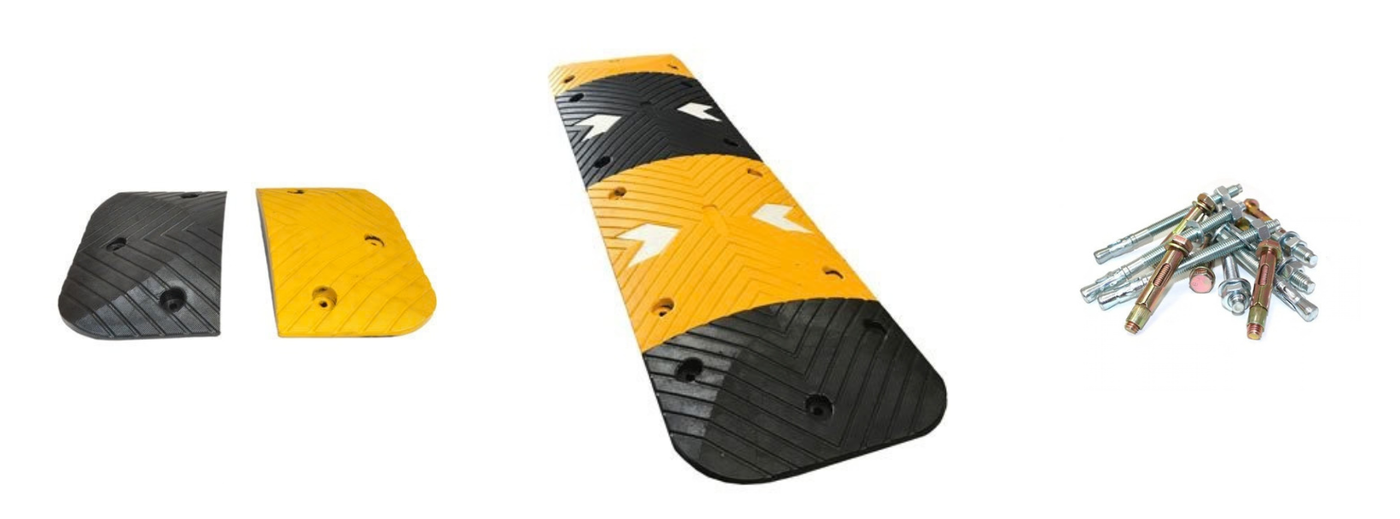
For instance, our 50mm Heavy Duty Speed Hump is built from solid rubber in a bright yellow and black design, with reflective beads moulded in for night-time visibility. Being a modular system, mid sections and end caps can be added or removed to suit the width of the space, and the whole unit is immediately traffic-able once installed.
Why Do Speed Humps Matter?
Speed humps play a straightforward but important role in site safety. They:
- Reduce vehicle speed in areas where pedestrians and vehicles share the same space, such as carparks and loading zones
- Improve pedestrian safety around entrances, walkways, and high-foot-traffic zones
- Support compliance with AS2890.1:2004, the Australian/New Zealand standard for off-street car parking, which speed humps should be positioned in line with
- Offer a durable, low-maintenance solution that holds up to repeated vehicle loads without warping, cracking, or fading
What to Know Before Installing
Before installing a speed hump, take a moment to plan the job properly:
- Position the speed hump according to AS2890.1:2004
- Check whether the surface is bitumen or concrete, as this determines your fixing method
- If installing onto concrete with a waterproof membrane, confirm whether piercing the surface is allowed, as this affects whether you’ll need to fix mechanically or use adhesive instead
Speed Hump Step by Step Installation Guide
Installing Onto Bitumen (Using M12 x 300mm Spikes)
- Position the speed hump according to AS2890.1:2004.
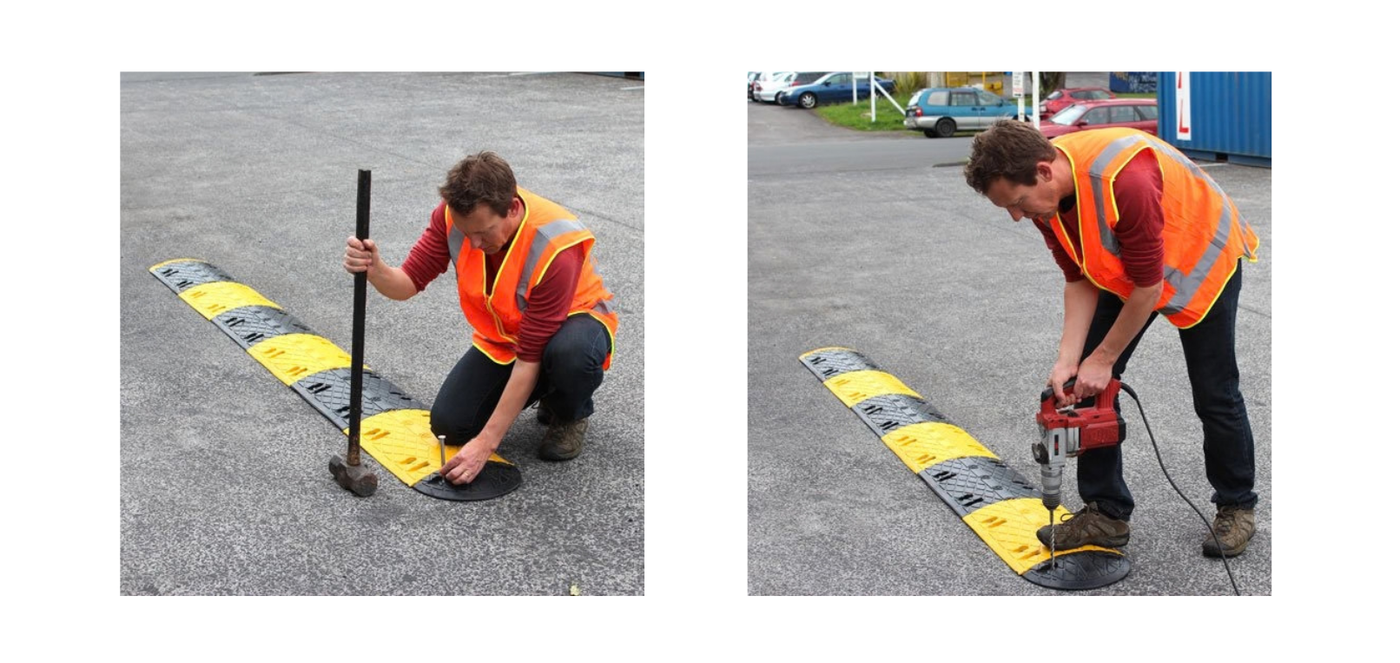
- Drill pilot holes approximately 50mm deep using a 10mm masonry bit.
- Drive the spiked fasteners in using a sledgehammer, ensuring the head of each fastener is driven fully into the rebated hole.
Installing Onto Concrete (Using M12 x 150mm Concrete Dyno Bolts)
- Position the speed hump according to AS2890.1:2004.
- Drill small pilot holes to mark your fixing points.
- Move the speed hump aside and drill out the pilot holes using a 12mm masonry bit. Holes must be 25mm deeper than the fixing penetration.
- Remove dust from the holes, reposition the speed hump, and insert the concrete dyno bolts.
- Wind the fixings in securely using a socket wrench or impact driver.
Installing Onto Concrete Using Adhesive (Where Piercing the Membrane Isn’t Allowed)
This method is used where the surface has a waterproof membrane that can’t be pierced. The surface must be clean, dry, and dust-free before you begin.
- Position the speed hump according to AS2890.1:2004.
- Chalk-mark the desired position, then place the speed hump onto its back.
- Spread epoxy around all ground-bearing edges and bridges of the speed hump.
- Place the hump into position and wriggle it slightly to embed the adhesive into both surfaces.
- Leave undisturbed for 24 hours before subjecting it to normal use. Full cure takes 7 days.
Getting It Right the First Time
Installation only needs doing once if it’s done properly. Taking the time to choose the correct fixing method for your surface, drilling to the right depth, and allowing adhesive to fully cure will save you from having to redo the job down the line.
If you’re planning a speed hump installation and want to talk through which fixing method suits your site, our team at Highway 1 is happy to help. As a New Zealand-owned business with years of experience supplying carpark and traffic safety products, we’re on hand to support you before, during, and after installation. You can check out our range of speed humps or get in touch at info@highway1.co.nz.
