


Blog
Does Your Variable Message Sign (VMS) Meet the NZTA Spec?
Sep
Buying a mobile variable message sign (VMS) is a long-term investment. A mobile VMS may spend years operating roadside in New Zealand conditions, often unattended and in situations where clear, reliable information is critical to road users.
So How Do You Know What You’re Actually Buying?
NZTA Waka Kotahi has published the Intelligent Transport Systems (ITS) Delivery Specification for Mobile Variable Message Signs (MVMS), which sets out the minimum requirements for procuring and deployment of trailer-mounted MVMS. While the document is currently classified as a “Final Draft,” NZTA states that it can be used for procurement at this status.
However, the NZTA MVMS specification doesn’t stand alone, and an EN 12966-certified LED display doesn’t automatically mean the complete mobile VMS meets every requirement of the NZTA specification.
Here are some things you must consider.
1. Start With the Display, But Don’t Stop There
The LED display is one of the most important components of any VMS. NZTA’s MVMS specification references EN 12966:2014+A1:2018, the European standard for variable message traffic signs, but it also links into a wider group of NZTA ITS standards and specifications.
These cover areas including:
- Display matrix and pixel control
- Electronic signage fonts
- Visual performance
- LED colour, luminance and beam width
- Controllers and system interfaces
- Electronic sign design
Some of these referenced documents were developed primarily for fixed VMS, so that doesn’t mean every fixed-VMS requirement automatically applies to every mobile VMS. However, where the MVMS specification specifically refers back to these requirements, they become relevant to understanding the performance expected from the mobile display.
For example, the MVMS specification requires LED elements to meet EN 12966 Class B6, providing a minimum 30-degree total beam width, and refers back to the Fixed VMS specification for LED colour palette, luminance and beam width.
Ask your supplier: What part of the VMS is actually EN 12966 certified? What classes has it achieved?
2. Not All EN 12966 VMS Are the Same
This is an important distinction. Two VMS products may both be described as EN 12966 certified, but that doesn’t necessarily mean they have the same display technology, optical performance, matrix, character capability or suitability for the same application.
NZTA recognises that the required display depends on the road environment. Its MVMS specification sets different minimum character heights depending on road type, number of lanes and speed environment, while also requiring standard NZTA electronic signage fonts.
For motorways and expressways, the specification specifically requires consideration of speed environment and sufficient visibility for the message to be read, as well as decision time ahead of interchanges.
At 100 km/h, NZTA calls for a site providing at least 300 metres clear sight distance to the MVMS. That makes the question much more useful than simply: “Is it EN 12966?”
Instead, ask your supplier: Is this particular EN 12966 display suitable for where I intend to use it?
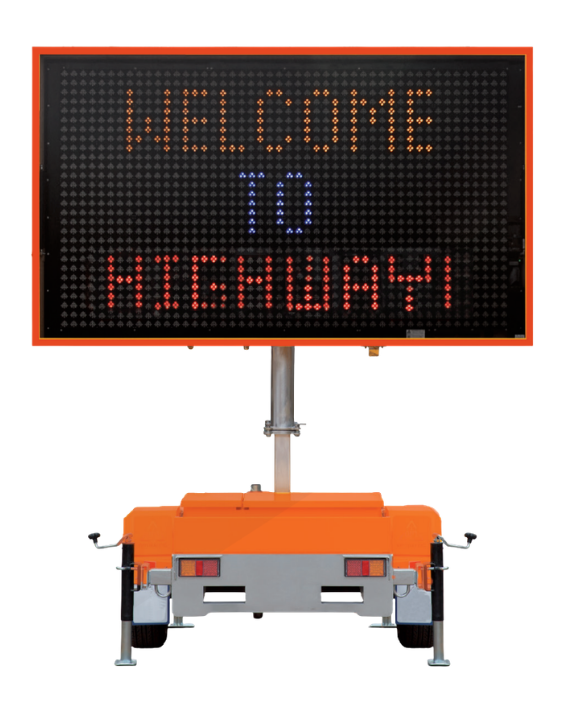
Highway 1’s mobile VMS uses L-Series EN 12966-certified display systems, bringing established EN 12966 display technology into a mobile trailer format.
3. The MVMS Specification Is More Than EN 12966
One of the easiest mistakes when comparing mobile VMS products is treating EN 12966 certification as certification of the complete machine.
NZTA’s MVMS specification covers the complete system, including the display, controller, communications, power supply, GPS, trailer and deployment requirements. It also specifically references other NZTA ITS documents, including:It also specifically references other NZTA ITS documents, including:
- ITS Delivery Specification: Variable Message Signs – Fixed
- ITS Core Requirements Standard: Electronic Message Signage Fonts
- ITS Core Requirements Standard: Variable Message Signs (VMS) and Lane and Carriageway Signs (LCS) System Interface
- ITS Design Standard: Electronic Signs – Fixed VMS, Mobile VMS and Lane and Carriageway Signs
Therefore, a certificate applying to the LED display shouldn’t automatically be interpreted as evidence that the entire mobile VMS meets every NZTA MVMS requirement.
Ask your supplier: Exactly what does your certification cover — the LED display, the controller, or the complete mobile VMS?
4. Controller, Communications and GPS Matter Too
A modern mobile VMS is more than a display and a remote control. The NZTA specification requires the MVMS to support both local and remote operation, with remote control through a cellular router. It also refers the controller back to requirements within the Fixed VMS and VMS/LCS system-interface standards, and specifically requires the MVMS controller to report the sign’s location and orientation.
This is an important consideration when comparing different generations and types of VMS technology. A display may have excellent optical performance, but the controller and communications platform determine how the complete VMS can be operated, monitored and potentially integrated into wider ITS systems.
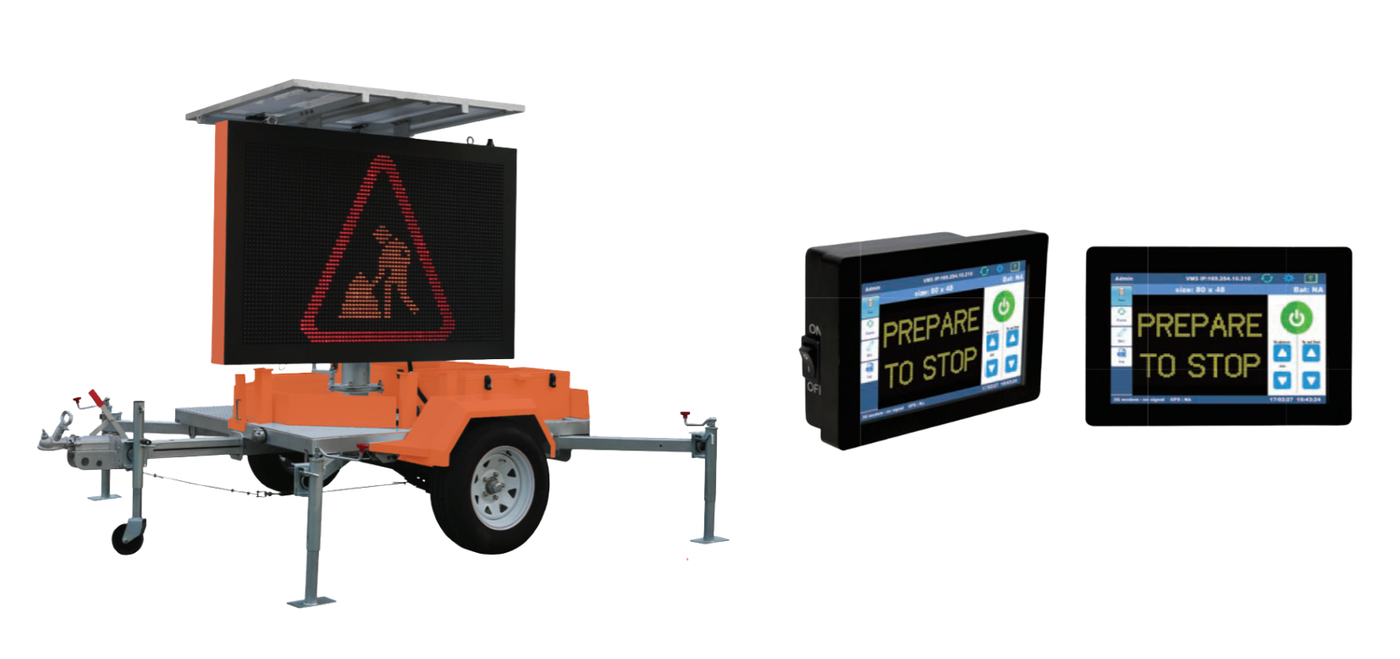
Ask your supplier: How is the VMS controlled remotely? What information can it report? What communications and GPS capability is built into the system?
5. Power Is About Autonomy, Not Just Battery Size
Solar panels and large batteries look impressive on a specification sheet, but NZTA defines the outcome the complete system needs to achieve.
The MVMS specification requires operation without mains electricity for 170 hours—one continuous week—using onboard batteries together with onboard generation. The batteries themselves must be capable of operating the sign for at least 48 hours without recharging and have a minimum design life of 24 months.
Importantly, NZTA also specifies how onboard generation is assessed. When simulating field conditions, generation without onboard fuel, such as solar, is operated at a maximum 50% efficiency during testing.
Comparing two VMS trailers on solar-panel wattage or battery capacity alone leaves out how the complete system actually performs in the field.
Ask your supplier: What evidence supports the claimed operating autonomy of the complete VMS?
6. Don’t Forget the Trailer
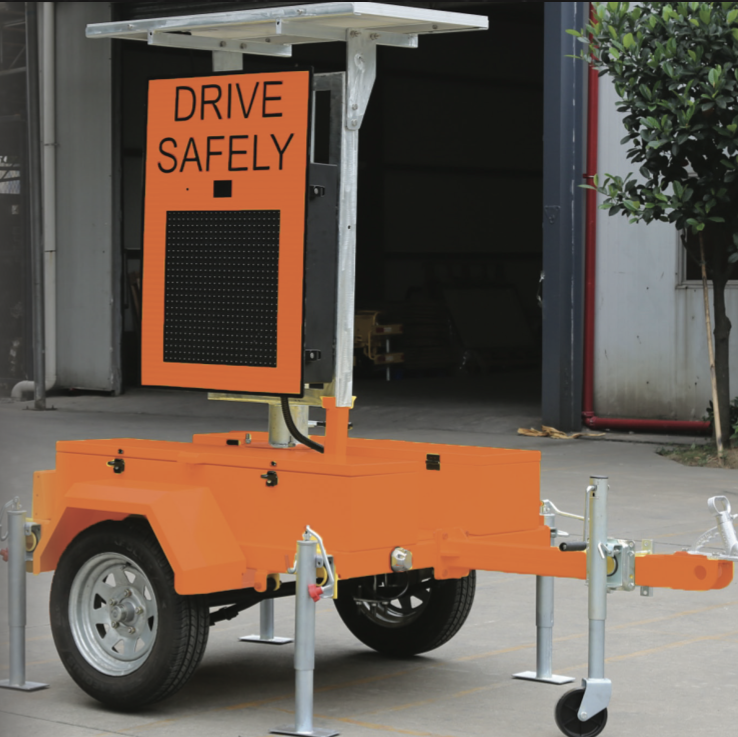
The VMS trailer underneath the display carries its own set of NZTA requirements. NZTA’s MVMS specification includes requirements covering trailer dimensions and weight, braking, stabilisers, safety chains, lash-down points and other aspects of transporting and deploying the VMS.
One particularly significant requirement is wind loading. In operating mode, NZTA specifies that the MVMS must be designed to withstand wind loadings from gusts of up to 180 km/h. That is a requirement worth asking about rather than assuming.
Ask your supplier: What wind loading has the trailer been designed for? What stabilisation or anchoring arrangements are required when deployed?
7. Built for Life on the Roadside
A mobile VMS has to survive considerably more than a showroom. NZTA specifies a 10-year design life for the MVMS and includes requirements covering corrosion resistance, mechanical impact and environmental protection. For the MVMS enclosure, the specification requires a minimum IP56 / P3 rating and references EN 12966 requirements for corrosion and mechanical protection.
Maintainability is also considered. The specification requires internal components to be replaceable on site, rear access for cleaning, minimised cyclic maintenance and no specialist tools outside security requirements.
Ask your supplier: What environmental and ingress-protection ratings apply, and how serviceable is the equipment once it has been operating in the field for several years?
8. Ask for the Evidence
We can’t reiterate this enough as it may be the most important question of all. Terms such as “EN 12966”, “NZ spec” or “NZTA compliant” can sound reassuring, but they shouldn’t replace technical evidence.
Ask to see what has actually been certified or tested. You should be able to know if the EN 12966 certification applies to the display you’re being offered; what EN classes were achieved; and what documentation supports the optical performance. You should also know what supports the power-autonomy claims as well as the trailer and wind-loading claims.
Ask your supplier: Can you provide the certification, test reports and technical documentation supporting the claims you’re making about this particular VMS?
Why This Matters More Than Price
There are good VMS products manufactured around the world, and there isn’t one VMS that’s right for every application. What matters is understanding what you’re buying, what it was designed to do, what standards it was designed and tested against, and whether those capabilities suit where you intend to use it.
If you’re weighing up a VMS purchase, we’re happy to walk through this guide against any product you’re considering, including our own. Send us an email via info@highway1.co.nz or call 0800 175 571.
