


Blog
Does Your Variable Message Sign (VMS) Meet the NZTA Spec?
Sep
Buying a mobile variable message sign (VMS) is a long-term investment. A trailer-mounted sign will sit on the roadside in all weather, run for years without a hitch, and needs to keep displaying clear, legible messages to keep road users safe. That’s why making the right choice matters.
The good news is that you don’t need to guess what “good” looks like. NZTA Waka Kotahi has published a delivery specification for Mobile Variable Message Signs (MVMS) that sets out exactly what a compliant sign and trailer should be able to do. It’s the document used for procurement on New Zealand roads, and it points back to the European standard EN 12966:2014+A1:2018 for most of the technical detail.
That gives you a proper guide to work from, while letting you know what to ask a provider when buying a VMS.
1. Display and Visibility
The display itself needs to meet EN 12966 requirements for full-colour variable message signs, including standard fonts and minimum character heights that scale with road type and speed environment. For LED performance, the spec calls for Class B6 elements with a minimum 30-degree total beam width, so the message stays visible from a realistic range of viewing angles.
Ask your supplier: Can you show me the sign meets EN 12966 for display and LED performance, not just a general product spec sheet?
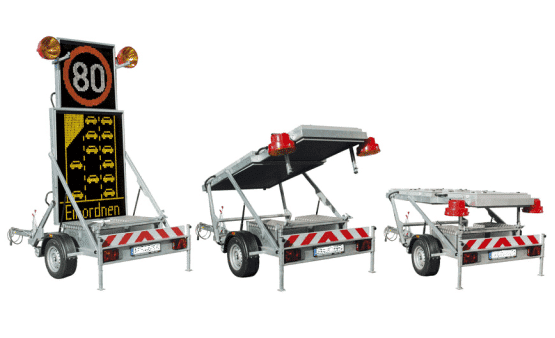
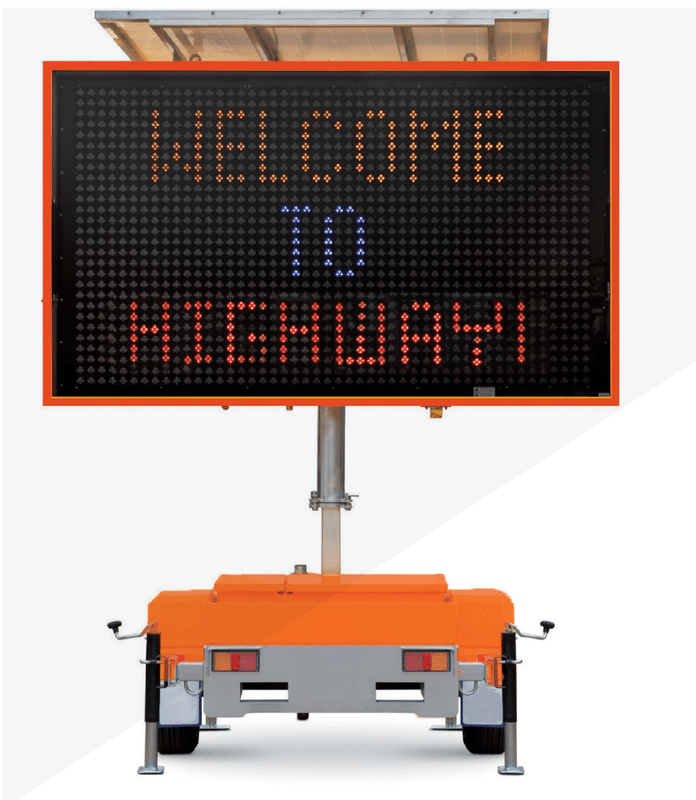
Highway 1’s AWVMS trailer is a good example of what to look for here. Its photometric type is approved by the German BASt against EN 12966, and the full matrix RGB display shows the complete range of standard traffic signs, arrows and text at up to 16.7 million colours with automatic brightness adjustment; the kind of documented, third-party-tested performance this guide is asking you to look for.
2. Build Quality and Durability
A roadside sign takes a beating. The spec requires resistance to surface corrosion, protection against water and dust ingress to a minimum IP56 rating, and protection against mechanical impact without the enclosure losing its structural integrity or ingress protection. The whole unit is expected to have a 10-year design life.
Ask your supplier: What IP rating does the enclosure carry, and what evidence backs up the 10-year design life claim?
3. Power and Reliability
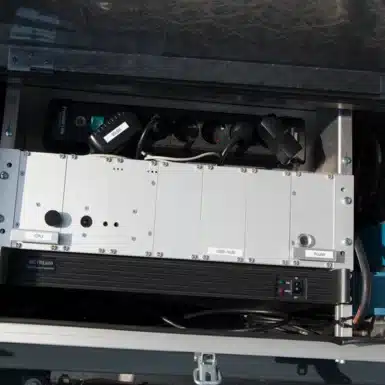
A VMS often runs unattended for extended periods. NZTA’s spec requires signs to operate for 170 hours (a full week) without mains power, using a combination of onboard batteries and generation such as solar. Batteries alone need to run the sign for at least 48 hours and carry a minimum design life of 24 months.
Ask your supplier: Can the unit run for a full week off-grid, and what’s the battery’s rated life?
4. Trailer and Transport
The trailer is engineered to hold a large sign steady in wind gusts up to 180km/h once deployed, while still being road-legal and towable by a light vehicle when packed down. That means compliant dimensions and weight, a proper braking system, stabiliser legs, and lashing-down points rated for design wind speeds.
Ask your supplier: What wind rating is the trailer designed for in operation mode, and does it meet NZ road-legal dimensions and braking requirements?
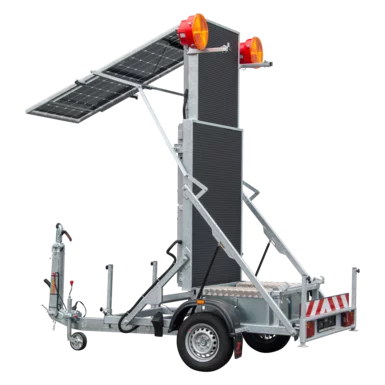
On our AWVMS trailer, the solar panel raises automatically as the LED board lifts, folds down for transport, and keeps charging batteries the whole time. It’s a small design detail, but it’s the sort of thing that separates a trailer engineered for unattended roadside deployment from one that isn’t.
5. Warranty and Support
NZTA’s reference specification calls for a 5-year warranty on the trailer and a 2-year warranty on the sign component as standard. Warranty terms are only worth as much as the support behind them, so it’s worth understanding who actually services the unit, holds parts, and answers the phone when something needs attention.
Ask your supplier: What’s the warranty on the trailer versus the sign, and who provides local servicing and parts?
6. Documentation
Every point above should be backed by paperwork, not just a conversation. A supplier who can point to genuine test certification, declarations of conformity, and compliance evidence against EN 12966 and the NZTA spec has done the work to prove the product stands up. A supplier who can’t produce that documentation is asking you to take it on faith.

Ask your supplier: Can you provide certification and compliance documentation I can keep on file for procurement purposes?
Why This Matters More Than Price
It’s easy to compare VMS units on sticker price alone. The specification exists because a sign that falls short on wind rating, ingress protection, or battery life doesn’t just perform worse. It can fail at the exact moment it’s needed most, on a roadside, in bad weather, with no one watching.
At Highway 1, we build our VMS trailer range around what NZTA actually specifies for procurement, and we back it with the workshop, parts, and technical knowledge to support it here in New Zealand for the long haul. If you’re weighing up a VMS purchase, we’re happy to walk through this guide against any product you’re considering, including our own. Send us an email via info@highway1.co.nz or call 0800 175 571.
